

Engineering protection for a safer tomorrow.
A passive physical shield designed to intercept drones at a distance from the asset. Flexible ring-net absorbs the strike inside its own stand-off space, away from the hangar, tank farm or substation behind it.
Concept visualisation
The threat
Drones are no longer a future risk.
They are a present one.
Modern UAVs bring more range, accuracy and payload,
and they are easy to get.
A single successful strike on a fuel store, a substation or an aircraft
can have major operational, economic and environmental consequences.
What is in the air
Small commercial
Tactical multirotor
Fixed‑wing / one‑way
Larger / higher‑energy
Three approach vectors.
Lateral, Oblique, Overhead. Fly each one at the envelope, then at a fence.
Choose an approach path to fly a drone in.
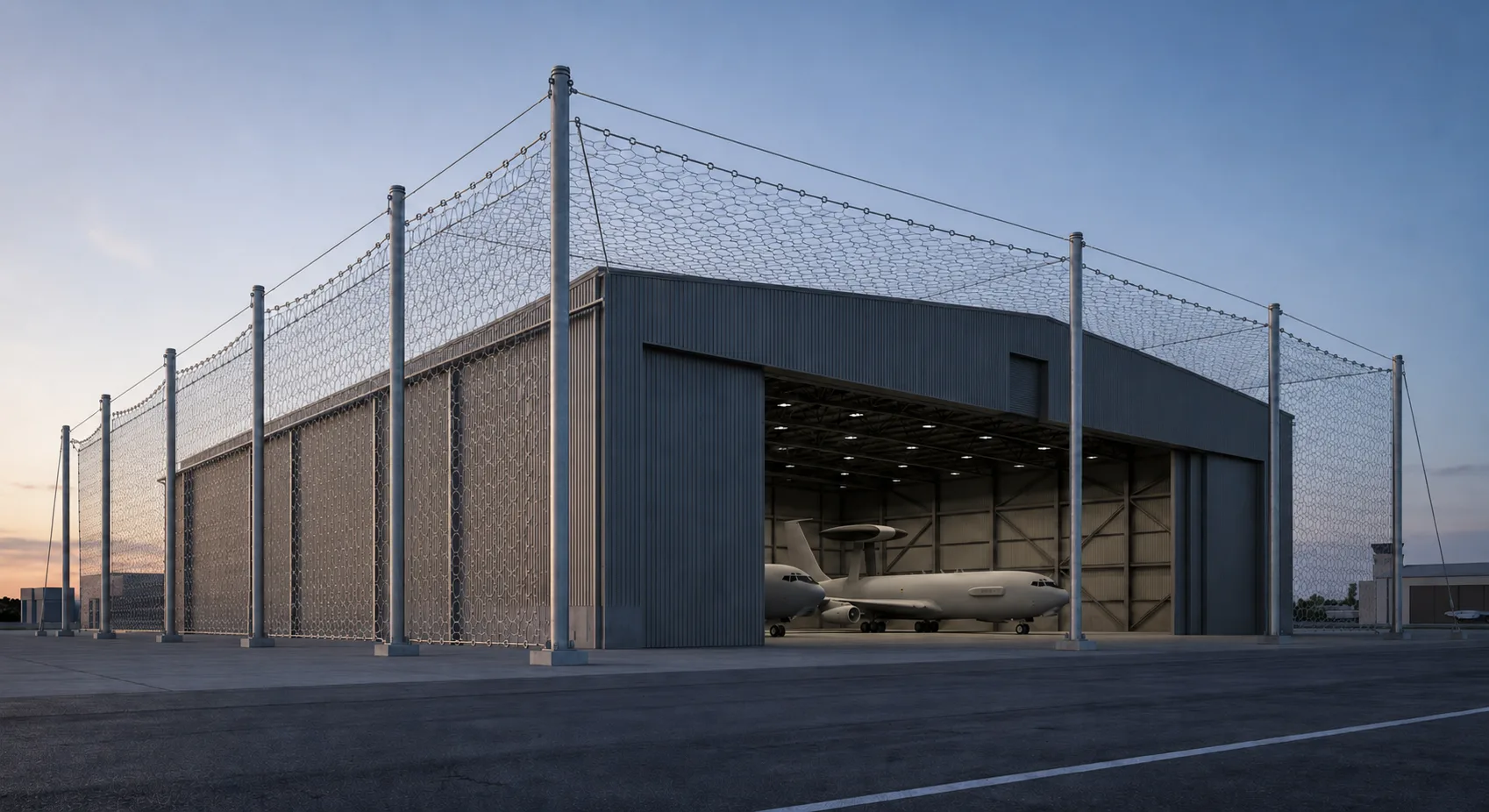
Aviation Concept visualisation
The envelope stands clear of the hangar. Doors and tow path stay open.
Built around the asset. Not onto it.
Ground fencing protects a boundary. The envelope protects the whole volume: sides, oblique angles and roof. The frame stands on its own foundations and stays structurally independent of the building.
Choose a layer to isolate it in the drawing.
Controlled deformation is the mechanism. Not rigid resistance.
The net is designed to move so the asset does not. A strike is managed in six stages.
01S1
Intercept
The drone meets the ring-net at a distance from the asset.
02S1
Deform
Rings stretch and the panel bows into its stand-off space.
03S1
Distribute
Force spreads across the net instead of one point.
04LT
Dissipate
Brake elements on the ropes absorb the remaining energy.
05LT
Transfer
Loads run through ropes and poles into the foundations.
06T2
Retain
T2 mesh is designed to hold debris and fragments above the protected roof.
Passive anti-drone protection
No detection.No electronics.No power.Always on.
Nothing to spoof
Nothing to jam
Nothing to switch off
Day, night, every season
It works alongside active counter-UAS systems. It does not replace them. When a drone gets through, the net is the last layer between it and the asset.
Reference tests of the barrier.
Full-scale impact tests from the barrier supplier, run with a test mass rather than a drone. They show how the flexible ring-net deforms, absorbs and holds; they are not qualification of a ZG Solutions anti-drone assembly.
Reference test basis: 1,000 kg · 25 m/s · 312.5 kJ
Lateral impact, test mass
The side panel deforms and arrests the mass
Vertical drop into the net
The net bows and holds
Net after impact
Rings hold around the strike point
No universal barrier. Every site is engineered.
Mass and speed set the impact energy. Approach angle, airframe, payload and site constraints set the geometry. Final stand-off and loop count follow the threat basis agreed with the client.
Ek = ½ m v²
The supplied flexible-barrier material states a kinetic design range of about 50–400 kJ. The 312.5 kJ test is a reference for barrier behaviour, not a claim about any drone or a project design threat.
Impact energy
kJ
Matches the manufacturer-declared reference test: a 1,000 kg test mass at 25 m/s. A test mass, not a drone.
Reference test: 1,000 kg test mass at 25 m/s (not a drone)
It has to survive the climate long before it meets a drone.
Site exposure
Marine and salt-laden air
Corrosion protection rated for the site's exposure category, with an optional duplex marine coating.
Heat, sun and UV
Materials and coatings chosen for high temperatures and years of solar exposure.
Wind, sand and dust
Structure, nets and fittings sized for site wind and abrasion.
Design standards
- BCP 2021 / ASCE 7
- Building Code of Pakistan loading
- AISC 360
- Structural steel: poles and framing
- EN 12385 / ASTM A1023
- Wire ropes and cables
- ISO 1461:2022 · ASTM A123
- Hot-dip galvanising
- ISO 12944-5 / -9
- Protective paint, C4/C5 or offshore
Sectors served
Defence & naval
Shore support, fuel, command and munitions storage.
Oil & gas
Production, processing, pipelines and distribution.
Strategic storage
Tank farms, fuel depots and critical reserves.
Power & utilities
Generation, substations and water infrastructure.
Ports & marine
Terminals, berths, marine assets and logistics.
Aviation
Hangars, aircraft and critical ground support.
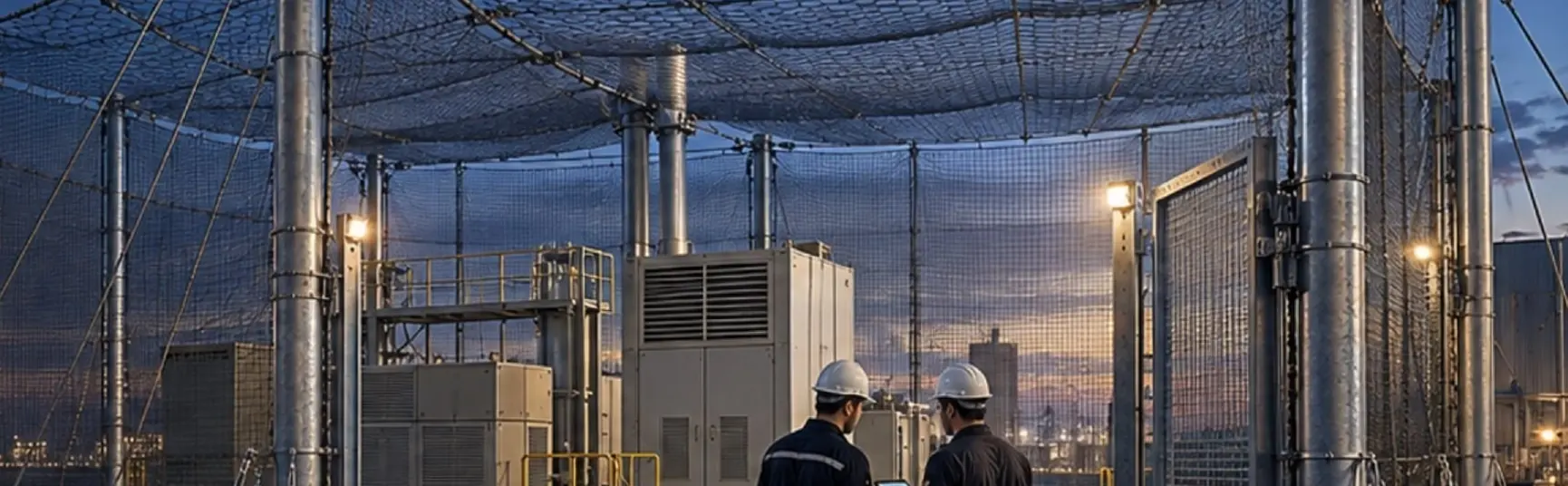
From site survey to handover, one responsibility.
01
Assess
- Priority asset
- Agreed threat and outcome
- Site survey
02
Engineer
- Protection geometry
- S1 / T1 / T2 architecture
- Structure and foundations
03
Validate
- Agreed analysis, testing or demonstration route
04
Deliver
- Manufacture and supply
- Installation and commissioning
- Site acceptance
05
Support
- Inspection and repair planning
- Replaceable components
- Return to service
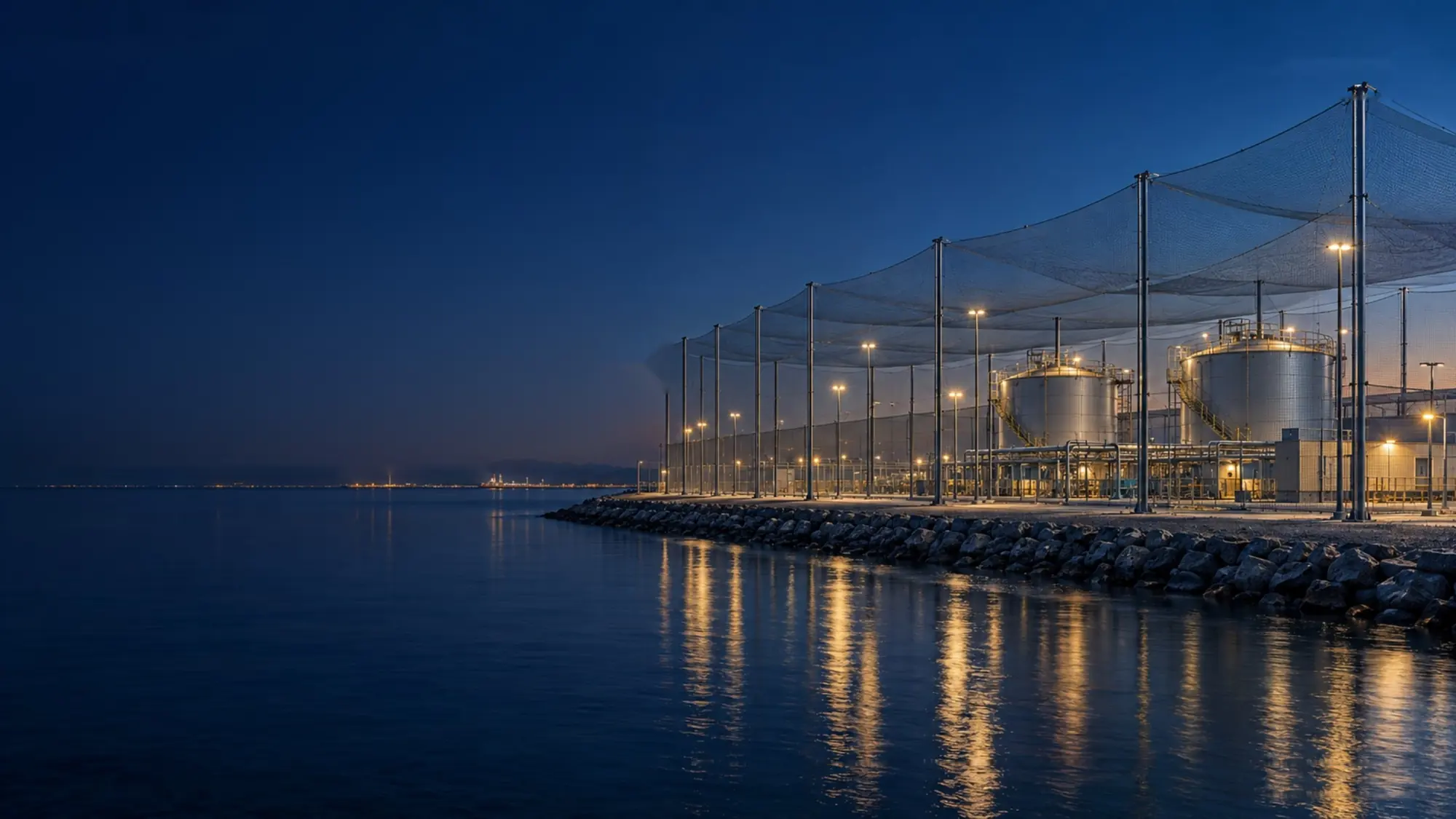
Name the asset. We'll engineer the shield.
Tell us the priority asset, the threat scenario you are planning for and the outcome you need. We will develop the site-specific configuration, engineering basis and validation route.
Pakistan office
69, Spring NorthBahria Town Phase 7, RawalpindiPakistanRiyadh office · Saudi Arabia
7th Floor, Shafi Building, Olaya StreetOlaya, Riyadh, Kingdom of Saudi Arabiazgsolutions.org